The Architecture of Harm: Product Liability and Mass Torts, Defective Design, PFAS Contamination, AI Liability,…
Investing in Rwanda’s Mining Sector: Legal Requirements for Investors
Investing in Rwanda’s Mining Sector: Legal Requirements for Investors
June 2, 2026 9:39 am
The Executive Summary
Mining in Rwanda as An Investment Opportunity: Rwanda’s mining sector continues to attract investor interest because the country has known deposits of tin, tungsten, tantalum, gold, gemstones and quarry materials, and the Government promotes mining as an investment opportunity through the Rwanda Development Board. As stipulated in Rwanda’s legal requirements for mining, RDB notes that trade in mineral substances is carried out by holders of mining and mineral trading licenses and owners of smelting companies, and that trading in minerals such as cassiterite, wolframite and niobium-tantalite must include at least 30% of value add.
For international investors, however, the key question is not only geological potential. It is whether a proposed project can meet the legal requirements for mining in Rwanda from licensing through operations, environmental compliance, tax reporting, land access and closure. As of 25 May 2026, the core statute is Law No. 072/2024 of 26/06/2024 on mining and quarry operations, published in the Official Gazette Special of 24/07/2024. Investors should also consider the 2024 minerals tax law, environmental impact assessment rules, Rwanda Mining Board guidance and mining safety standards.
Legal Considerations:
1. State ownership of minerals
A central principle of the Rwanda mining law is that minerals are not privately owned merely because they are located on private land. Article 3 of Law No. 072/2024 provides that rights of ownership and control of minerals and quarry products in, under or upon land in Rwanda are vested in the State. The Rwanda Mines, Petroleum and Gas Board’s investor guidance summarizes the same principle: “mineral resources found in Rwanda belong to the State regardless of land ownership.”
The practical implication is clear: before starting a mine in Rwanda, an investor must secure the appropriate Rwanda mining licenses and related approvals. Therefore, a land lease, land purchase agreement or cooperation agreement with a landowner does not replace the statutory license.
2. Rwanda mining licenses: exploration, mining, quarry, trading and processing
Law No. 072/2024 establishes a structured licensing framework for mining and quarry activities. Applications are addressed to the competent organ and processed through the One Stop Centre, with assessment by a specialized committee under the law. The Rwanda Mines, Petroleum and Gas Board states that its Geological Information and Mining Cadastre System is used by RMB and district staff to process applications for mining and quarry licenses.
Key License Categories Include:
- Exploration license: Article 7 of Law No. 072/2024 includes an exploration operations license. Article 13 provides an initial period not exceeding four years, and Article 14 allows one renewal for a period not exceeding four years.
- Mining licenses: Article 7 covers small-scale, medium-scale and large-scale mining licenses. Article 13 states that a mining license is granted for an initial period not exceeding 15 years, with the specific term determined by the approved feasibility study and project implementation programme. Article 14 allows renewal more than once, each renewal not exceeding 15 years.
- Quarry licenses: Article 28 provides for non-commercial small-scale quarry, commercial small-scale quarry and industrial quarry licenses. Article 30 provides durations of one year for non-commercial small-scale quarry licenses, five years for commercial small-scale quarry licenses and up to 15 years for industrial quarry licenses, determined by the project’s feasibility study.
- Mineral processing license: Article 19 requires a mineral processing license for mineral processing activities.
- Mineral trading license: Article 20 requires a mineral trading license for mineral trading activities, and RDB confirms that mineral trade is carried out by holders of mining and mineral trading licenses and owners of smelting companies.
Investors should also monitor license conditions after grant. Law No. 072/2024 requires exploration operations to start within 90 days and mining operations within 180 days after license issuance, and regulates renewal, transfer, relinquishment and reporting.
3. Environmental and Social Obligations
Environmental and social compliance is a core requirement for mining in Rwanda. Law No. 072/2024 requires compliance with environmental laws, an approved environmental and social impact assessment before commencement, rehabilitation of damaged areas, a rehabilitation plan and a rehabilitation guarantee.
The REMA EIA Guidelines for mining projects state that the EIA framework covers research, exploration, exploitation, processing, decommissioning and restoration activities. The guidelines describe project screening, scoping, environmental impact study, public participation and an Environmental Management Plan with mitigation and monitoring measures.
In practice, investors should plan for:
- Early environmental screening before committing capital;
- Consultation with affected communities, landowners and local authorities;
- An Environmental Management Plan for water, dust, waste, sediment, tailings and hazardous materials;
- Budgeted closure and rehabilitation costs; and
- A rehabilitation guarantee before or during operations, as required by the law.
Article 74 of the same law also requires participation in the development of the area of mining or quarry operations, including cooperation with district authorities on local development and social welfare planning.
4. Financial, Tax, Procurement and Reporting Duties
Mining operators must maintain accounting records, submit annual financial statements and meet taxes, royalties and service fees under Law No. 072/2024. Article 72 also requires procurement of local goods and services, giving preference to Rwandan contractors and locally produced materials where applicable.
Minerals tax is separately governed by Law No. 056/2024 of 26/06/2024 establishing tax on minerals. RRA says that mining royalty tax rates include the 3% for base metals and energy minerals, 2% for gemstones, 2% for platinum group metals and rare earth elements, and 0.5% for gold. For minerals exported in raw form, export tax rates include 2% for base metals, energy minerals and platinum group metals, 3% for gemstones, 1% for rare earth elements and 0.5% for gold.
The same law requires a local mineral processing facility or exporter to withhold mining royalty tax, declare it and remit it to the tax administration; export taxes must be declared and paid before minerals leave Rwanda. Investors therefore should align license reporting, export documentation, mineral traceability and tax filings from the start of operations.
5. Health and Safety Standards
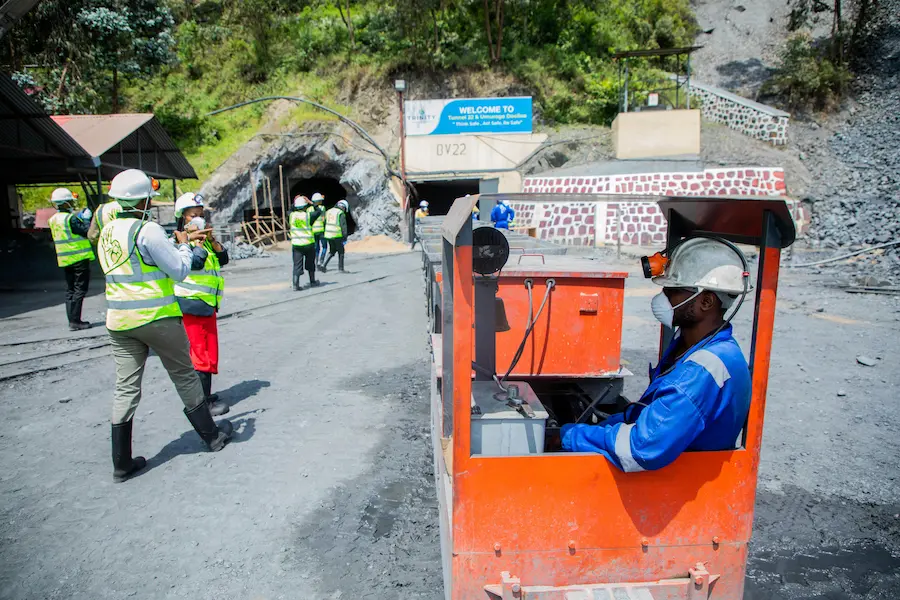
Health and safety is both a legal and operational requirement. Article 42 of Law No. 072/2024 requires protection of workers’ health and safety in mining and quarry operations. The RMB Mining Safety Standards also provide a best-practice framework for managing hazards and risks in underground mining and open pit mines.
A prudent operator should implement:
- Written risk assessments and safe operating procedures;
- Training, supervision and personal protective equipment;
- Ground control, ventilation, explosives controls and emergency plans;
- Incident reporting and corrective action systems; and
- Contractor safety management.
6. Landowner Compensation
State ownership of minerals does not remove land rights. Article 4 of Law No. 072/2024 provides that where a mineral deposit is discovered on land, the license holder must provide fair compensation to the landowner or lawful occupier before mining operations commence. For investors, this means land access, valuation, compensation agreements and community engagement should be handled before site mobilization, not after machinery arrives.
7. Penalties for Non-compliance
Non-compliance can trigger both administrative and criminal consequences. Law No. 072/2024 was drafted to include adverse administrative sanctions for issues such as minerals without proof of origin, delayed or incorrect reports, failure to keep required documents, failure to fix mine boundaries, failure to pay required fees, failure to insure employees, refusal of official access, failure to start operations and failure to rehabilitate damaged areas. Article 50 imposes a 10% administrative fine based on the value of minerals where a person is caught with minerals without proof of origin, and the minerals are confiscated for auction; Article 51 provides an administrative fine of FRW 500,000 for specified reporting, document, suspension and boundary failures in mining operations.
The law also creates criminal offences for undertaking mining operations without a license, possessing illegally extracted minerals, trading in illegally extracted minerals, allowing unlicensed mining activity on land, undertaking quarry operations without a quarry license, trading illegally extracted quarry products and unlawful activities involving dynamite. Official extraction of Article 63 confirms that undertaking mining operations without a license may result in imprisonment of 2 to 5 years and a fine that may reach FRW 50,000,000; illegal mineral trading is also treated as a serious offence under the criminal penalty provisions of the law.
Conclusion: compliance should be built into the investment plan
Rwanda offers real opportunities for responsible investors in exploration, mining, quarrying, mineral trading and processing. But Rwanda’s legal requirements for mining are detailed and must be addressed before capital is deployed. A compliant project should begin with the correct license, an approved environmental and social assessment, a land compensation strategy, a health and safety system, mineral traceability, tax compliance and a plan for local procurement, community development and rehabilitation.
For investors considering starting a mine in Rwanda or expanding existing operations, early legal due diligence can reduce regulatory delays, protect the license and support constructive relationships with regulators, communities and commercial partners.
Call to action: Stabit Advocates advises local and international clients on Rwanda’s legal requirements for mining including; Rwanda mining law, Rwanda mining licenses, investment structuring, regulatory compliance, land access, environmental obligations and dispute resolution and prevention. Contact Stabit Advocates for tailored legal support for your mining, quarry, trading or processing project in Rwanda.
Contact Information
Stabit Advocates
Website: www.stabitadvocates.com
Email: info@stabitadvocates.com
Phone: +250 789 366 274
For more information or to discuss your case, please contact us at www.stabitadvocates.com.
This guide is intended to provide general information and does not constitute legal advice. For specific legal advice tailored to your situation, please consult with a qualified attorney at Stabit Advocates.
This Post Has 0 Comments